
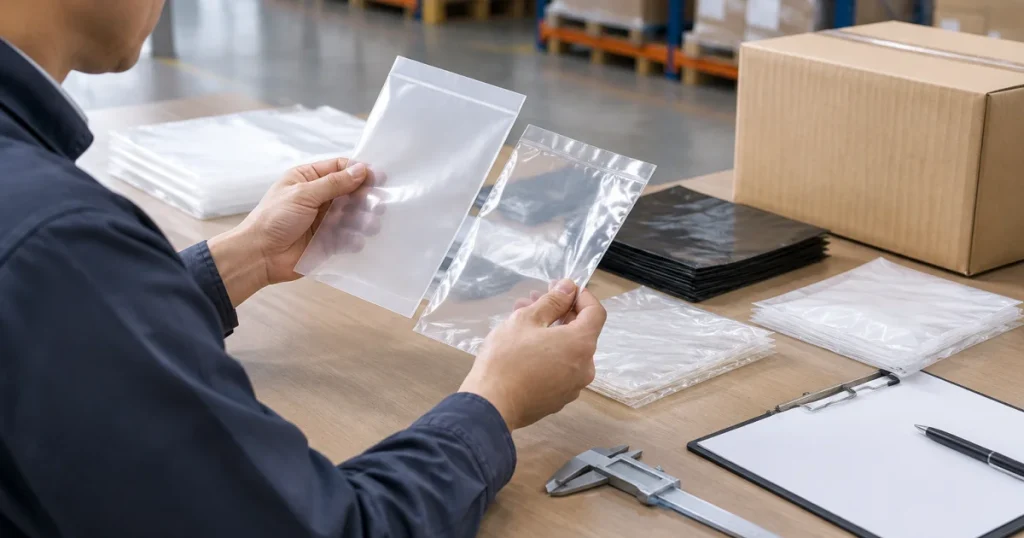
Buying plastic bags for business use looks simple until a “same bag” arrives and suddenly the thickness feels different, seals split during packing, or delivery dates slip and disrupt operations. If you are sourcing for retail, warehouse dispatch, food handling, or light manufacturing, the safest approach is to treat every quotation as a specification exercise—not just a price comparison.
This article shares what I would ask a Plastic Bags Supplier Penang purchasers commonly evaluate, with an opinionated focus: fewer assumptions, more written confirmation. Some points are facts about how plastic bag specifications work (e.g., thickness, material, and tolerances). Other points are judgment calls based on what tends to go wrong in real procurement (e.g., how to test samples and how to interpret a supplier’s “standard”).
1) Minimum order and pricing: clarify the “real MOQ” (and what changes it)
Most suppliers will state a minimum order quantity (MOQ), but in practice there are multiple “minimums” depending on how the bag is produced and packed. My view: don’t accept a single MOQ number without understanding what drives it, because MOQ affects cash flow, storage space, and the risk of being stuck with an unsuitable bag.
Ask these questions and insist on clear answers in writing:
- Is MOQ based on pieces, kilograms, or cartons? Some bags are quoted by weight; two “same size” bags can differ in weight if thickness changes.
- Is MOQ different for plain vs printed bags? Printing, colour matching, and plate setup can raise the minimum run.
- Does MOQ change by size, thickness, or material type? A thicker bag or different resin blend may require a different setup or raw material planning.
- Can you combine sizes or types in one purchase order to reach MOQ? Useful when you have several SKUs but smaller volumes for each.
- What is included in the unit price? Confirm packaging (carton type, inner packing), printing, and delivery terms.
Opinion: I prefer suppliers who can explain MOQ as a production constraint (machine setup, material purchasing, printing setup) rather than “because that’s our policy.” The first signals you can negotiate with trade-offs (e.g., longer lead time, standard packaging, fewer colour changes) instead of arguing over a fixed number.
2) Thickness and performance: stop buying by “feel” and start buying by spec
Thickness is the most common source of dispute. Buyers describe a bag as “0.05” or “2 mil,” while suppliers may quote microns, gauge, or thickness ranges. The key is to specify thickness and how it will be verified, because film can vary across the bag and between batches.
Questions to ask about thickness and measurement
- What thickness unit do you quote in (micron, mm, gauge)? Ask them to state it clearly on quotation and delivery order.
- Is thickness a target or a guaranteed minimum? “Average 50 micron” is different from “not less than 50 micron.”
- What tolerance do you allow per batch? You don’t need a complex standard—just a clear range.
- Where is thickness measured? Side gusset areas, seams, and near handles can measure differently.
- Can you provide a small sample with a measured thickness record? Even a simple check helps align expectations.
Questions to ask about real-world performance
Thickness alone does not guarantee strength. Material type and bag construction matter too. Ask:
- What material is it (e.g., HDPE/LDPE/LLDPE blend)? Different resins affect stiffness, clarity, and tear resistance.
- What sealing method is used and how strong is the bottom seal? Seal failure is a common packing-line headache.
- Is the bag suitable for sharp edges or heavy loads? If you pack cartons with corners or metal parts, you need puncture resistance, not just thickness.
- Does the bag have anti-slip or easy-open characteristics? For fast packing, bag opening and handling matter.
Opinion: If your operation depends on consistent bag behaviour (auto-bagging, packing counters, dispatch lines), ask for a short trial run and treat it as a qualification step. A small “test PO” can be cheaper than a large reorder when bags jam a process.
3) Compliance and suitability: ask for documents that match your use case
“Compliance” means different things depending on where the bag will be used. A warehouse liner bag, a retail carry bag, and a bag that touches food all have different risk levels. Because requirements can vary by application and customer audits, keep your request practical: ask the supplier to show what they can provide, and then check that it matches your customer’s expectations.
Ask the supplier:
- What is the intended use category of this bag? For example: general packaging, retail carrier, bin liner, or food-contact handling.
- Can you provide material declarations or product specification sheets? Even a basic document (material type, thickness, dimensions, colour) helps internal approval.
- Do you provide supporting paperwork for audits? Some buyers need documents for QA, customer requirements, or internal procurement control.
- Are there any limitations we should know? For instance, “not recommended for direct high-heat contact,” or “not for long-term outdoor exposure.”
Important note: This is not legal advice. If you serve food and beverage, pharmaceuticals, or export customers with specific requirements, confirm your required standards with your QA team and ask the supplier to confirm in writing what they can support for that specific bag grade.
4) Delivery and lead time: confirm what “ready stock” really means
Delivery reliability is often the hidden cost. A slightly cheaper bag is not cheaper if you have to stop packing, send staff to buy emergency stock, or rush transport. When evaluating Plastic Packaging Penang options, I recommend pushing for clarity on what is stocked vs produced-to-order.
Ask these questions:
- Is this item ex-stock, or produced after PO? If ex-stock, ask what quantity is typically available.
- What is the standard lead time and what causes delays? Printing, colour changes, raw material availability, and peak seasons can matter.
- What are your order cut-off times for next-day or same-week dispatch? Helpful for routine replenishment planning.
- How is delivery charged and scheduled? Confirm delivery days, drop-off constraints, and any surcharge for urgent runs.
- How do you handle partial deliveries? Sometimes you need a partial to keep operations running while the balance follows.
Opinion: The best suppliers are not always the fastest; they are the most predictable. Look for suppliers who can propose a simple replenishment rhythm (e.g., monthly forecast, safety stock suggestion, call-off arrangement) rather than reacting to every order as a fire drill.
5) Quality control and returns: agree on acceptance criteria before the first carton arrives
Many disputes happen because buyers and suppliers never agreed on what counts as “acceptable.” You can prevent most of this by defining a small set of acceptance criteria that matter to your operation. Keep it simple and measurable.
Here is a practical checklist you can use during evaluation:
- Dimensions: width, length, and gusset (if applicable). Confirm tolerances.
- Thickness: target and acceptable range; how it’s measured.
- Seal strength: bottom seal integrity under your typical load.
- Print quality (if printed): colour consistency, smudging, alignment.
- Defects: holes, contamination, excessive odour, blocking (bags sticking together).
- Packaging: carton labeling, inner packing quantity, moisture protection during transport.
And ask the supplier directly:
- What is your defect/claim process and timeline? How quickly must you report an issue?
- Will you replace, credit, or rework? Clarify typical resolutions.
- Do you keep batch identification? Even a simple batch reference on cartons helps trace issues.
Quick comparison table: questions that separate “cheap” from “safe to reorder”
| Decision area | What to ask | Why it matters | What a good answer looks like |
|---|---|---|---|
| MOQ & pricing | Is MOQ by pcs/kg/carton? Can SKUs be mixed to meet MOQ? | Controls cash tied up and storage risk | Clear MOQ basis and options (standard size, standard packing, call-off) |
| Thickness | Thickness unit, tolerance, and where it’s measured | Prevents “feels thinner” disputes | Written spec with a range and measurement method |
| Material & strength | Resin type/blend, seal method, puncture/tear suitability | Thickness alone doesn’t guarantee performance | Recommendation based on your load and handling conditions |
| Compliance support | What documents can you provide for our use (spec sheet, declarations)? | Helps internal QA and customer audits | Supplier asks your use case and confirms document availability in writing |
| Delivery | Ex-stock vs made-to-order, lead time, cut-off, partial delivery options | Avoids packing disruption | Specific lead times and a predictable delivery schedule |
| Claims & returns | Acceptance criteria, claim window, replacement/credit process | Reduces costly arguments when defects occur | Simple claim SOP and traceable batch/carton references |
My recommended buying process (especially for first-time supplier trials)
If you are comparing vendors and want to reduce risk without overcomplicating the purchase, here’s a process that works well for many operational buyers:
- Define the use case: what goes inside, approximate weight, whether corners are sharp, whether it touches food, and how it’s handled (manual packing vs line).
- Request two samples: one at the supplier’s recommended spec, and one slightly upgraded (e.g., thicker or different material). This reveals how they think about performance.
- Run a short trial: pack real products for a day or a shift. Observe tear, seal splits, and handling speed.
- Lock the written spec: dimensions, thickness unit and tolerance, material type, colour, and packaging count per carton.
- Place a test PO before committing to a long-term volume: especially if printing is involved or your items are heavy.
- Agree on replenishment and lead time: set re-order points and confirm delivery schedule for Penang destinations.
Opinion: Buyers often spend too much time negotiating cents per unit and not enough time negotiating predictability. The most valuable outcome is a repeatable spec and a supplier who can keep it consistent.
Conclusion: the best questions create a bag spec you can reorder with confidence
When you evaluate a Plastic Bags Supplier Penang businesses rely on, focus on four pillars: MOQ realities, thickness plus performance, compliance support for your use case, and delivery predictability. Add a simple QC/claims agreement and you greatly reduce the chance of costly reorders, packing interruptions, or audit surprises.
If you’d like.
Frequently Asked Questions
What details should I include when requesting a quote for plastic bags in Penang?
Provide bag type (carry bag/liner/packaging), dimensions (width x length + gusset), thickness unit (micron/mm) with tolerance, material preference (if any), colour/printing, packing per carton, and delivery location. The clearer your spec, the more comparable supplier quotes will be.
How do I verify thickness without special lab equipment?
Ask for the supplier’s stated thickness and tolerance in writing, then check samples using a basic thickness gauge/caliper at several points (not only at seams). Record results and test the bag under your real packing load. Consistent results matter more than a single reading.
Is thicker always better for plastic bags used in warehouses or retail?
Not always. Thickness helps, but material type and seal quality often decide whether bags tear or split. A slightly thinner bag with better tear resistance can outperform a thicker but brittle film. The safest approach is a short trial using your actual products and handling method.
What compliance documents can a supplier usually provide for business purchasing?
Many suppliers can provide a basic product specification sheet and material declaration for the bag grade. If you have food handling, pharma, or customer-audit requirements, share the exact use case and ask what supporting documentation they can provide for that specific product, in writing.
What delivery questions matter most when setting up a repeat order in Penang?
Confirm whether items are ex-stock or made-to-order, typical lead time, order cut-off time, delivery days/routes, and whether partial deliveries are possible. Also confirm how delivery charges are calculated. Predictability is often more important than the shortest promised lead time.
Need a reliable supply setup for plastic packaging and bags?
Dai Ichi Supply Sdn Bhd supports businesses with plastic packaging and bags alongside a wide range of industrial and commercial essentials—plastic pallets, industrial containers, garbage bins, medical waste containers, and storage solutions. Share your application (dimensions, thickness, usage, and delivery needs) and our team can help you narrow the right specification for smoother repeat orders.